Family business advisory
Control Is Not Care: The Founder Trap That Blocks Succession

TL;DR
In many family businesses, the founder still signs every cheque, approves every hire, and steps into every crisis. It looks like care. It feels like responsibility. Over time, it becomes control. The next generation never gets to lead while you are still there to guide them. So when handover day comes, they inherit ownership without the judgment that ownership needs. Real succession is not about holding tighter. It is about transferring clarity, authority, and trust on purpose, through the Inner Operating System that actually runs the business.
The sentence founders say with love
"I am doing this for the family."
That sentence is honest. Most founders mean it. They stayed late so the business would survive. They carried risk so their children would not have to. They built systems with their own hands because nobody else could see the whole picture yet.
Then the children grow up. They join the company. Titles appear on the letterhead. And still, every hard call comes back to the founder.
The family calls this involvement. The next generation often experiences it as being managed, not mentored. That is the trap: control dressed up as care.
What control looks like in a family business
Control rarely announces itself. It shows up in small habits that feel normal after 20 or 30 years.
- Every decision still needs your yes. Even the ones you said they own.
- Staff still come to you first. The org chart says otherwise. The room knows who has power.
- Mistakes get fixed by you, not owned by them. So learning never sticks.
- Succession stays "soon". The papers are ready. The timeline is not.
None of this means you do not love your children. It means the business still runs on your nervous system, not on a shared way of thinking.
Sandeep Amar Guppta calls that shared way of thinking the Inner Operating System: the clarity, values, and decision logic beneath every visible result. Strategy and titles are the outer layer. Without the inner layer, handover is theatre.
Why the next generation goes quiet
When founders keep control, the next generation adapts. Some stop offering ideas. Some build a second career on the side. Some stay polite in meetings and honest only with their spouse.
Research on family firms keeps returning to the same pattern: survival across generations is low not because children lack talent, but because authority and wisdom are not transferred together. You can hand over shares and still keep the real job.
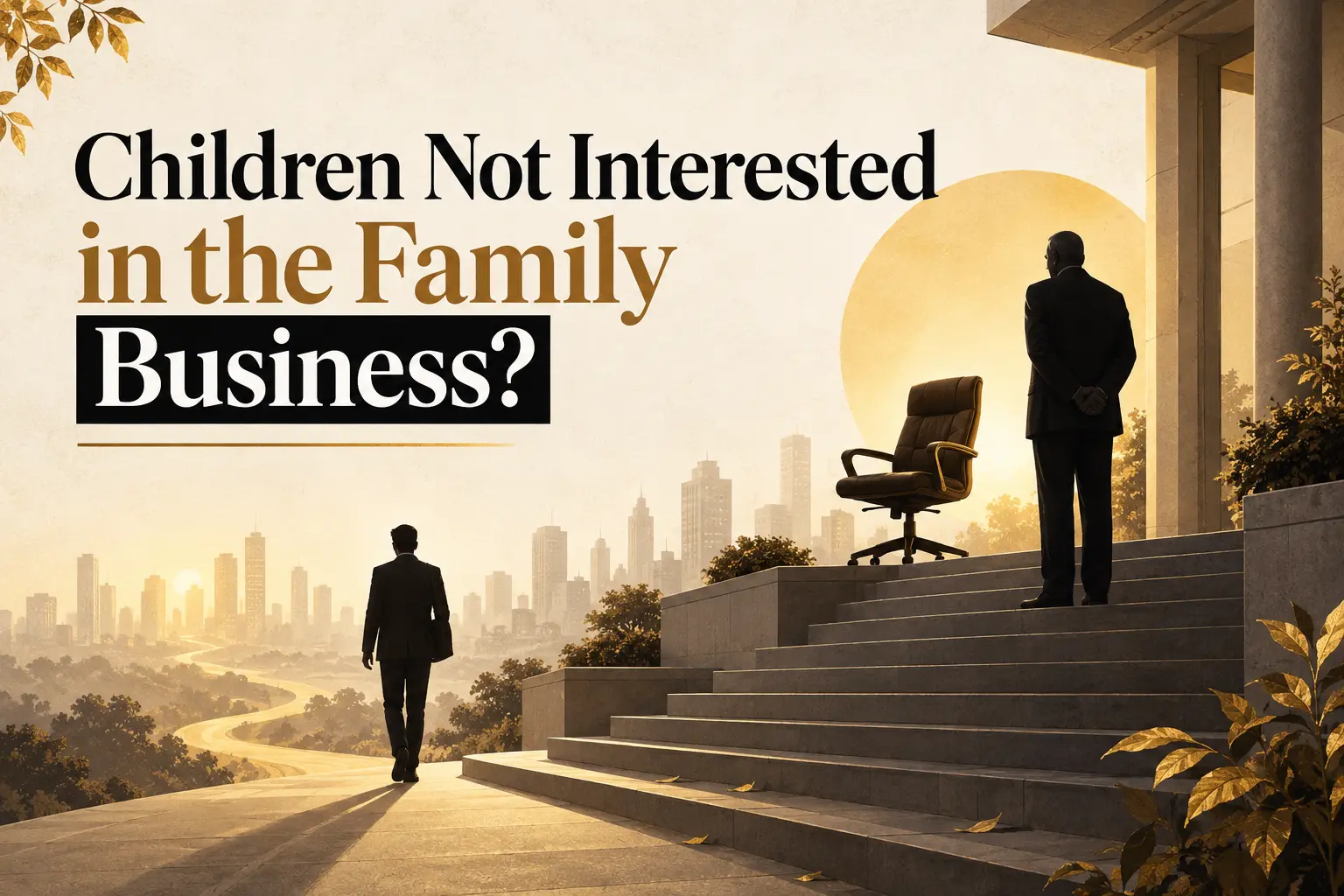
If your children have already said they are not sure about joining, read Children Not Interested in the Family Business? What to Do. Often the "no" is a response to a role with no real room.
Care looks different from control
Care prepares people to stand without you. Control keeps them dependent on you.
| Control | Care |
|---|---|
| You fix every problem | You stay present while they solve it |
| You keep the final say forever | You set a timeline for real authority |
| You protect them from hard conversations | You put the hard conversations on the table |
| You pass wealth and hope for the best | You transfer judgment, values, and decision logic |
Care is harder in the short term. You watch them stumble. You feel the urge to take the wheel. That urge is exactly what succession work has to face.
The Inner Operating System behind a clean handover
Family business advisory that only updates legal documents leaves the human part untouched. The work that lasts sits in three places at once, which is why Sandeep built The S.H.E. Framework:
- Spiritual Dynamics: What you will not compromise, even under pressure.
- Human Potential: How the next generation grows into leadership without becoming a copy of you.
- Economic Strategy: How ownership, roles, and money stay clear while relationships stay intact.
When only the economic piece moves, families get inheritance. When all three move together, families get succession. That is the difference between a business that changes names and a legacy that keeps its centre.
Keynotes and workshops help when a whole room needs the same language. Advisory helps when one family needs a private path. Both point to the same outcome: less holding on, more conscious transfer.
Five moves that turn control into care
- Name one decision they own this quarter. Write it down. Tell the team. Do not reverse it when you feel nervous.
- Explain your why once a week. Not the result of a call. The thinking behind it. That is wisdom transfer.
- Let a mistake stand long enough to teach. Rescue only when the business is truly at risk.
- Separate ownership from day-to-day management. Titles without authority create resentment. Clear roles create room. See Ownership vs Management in a Family Business.
- Set a public timeline for stepping back. "Soon" is not a plan. A date is.
A question only you can answer
If you were unavailable for 90 days, what would break first: the systems, or the habit of asking you?
If the honest answer is "everything still comes to me", you do not have a succession plan yet. You have a dependency plan. The good news is that dependency can change while you are still present, which is the only time it changes well.
If you want help putting that conversation and structure in place for your family, start at Work Together or explore Family Business Succession.
About Sandeep Amar Guppta
Known as 'The Consciousness Man,' Sandeep Amar Guppta is an international keynote speaker, author, and creator of The S.H.E. Framework. He helps founders, business families, and leadership teams build organisations that outlast them by aligning Spiritual Dynamics, Human Potential, and Economic Strategy through mastery of their Inner Operating System.
A Fellow Chartered Accountant with a postgraduate diploma in Theology, he is also certified in Design Thinking and Interpersonal Neurobiology. He has spoken at Oxford University, the Science of Consciousness Conference, the ISUD World Congress, and global corporate forums.
He writes for leaders who want conscious profitability, enduring organisations, and legacies that matter.
Work with Sandeep: https://sandeepamarguppta.com/work-together
Frequently Asked Questions
How do I know if I am controlling instead of caring?
Ask whether the next generation can make a meaningful decision without you, and whether the team still routes around them to reach you. If authority exists only on paper, you are still in control.
Will letting go put the business at risk?
Sudden abandonment does. Gradual transfer with clear values, coaching, and a timeline reduces risk. Holding everything yourself until the last day creates a larger risk on day one of handover.
What should we transfer besides shares?
Judgment, non-negotiables, relationship logic, and how risk is read. That is succession. Shares alone are inheritance.
Where do workshops and keynotes fit?
They give the family and leadership team a shared language for inner clarity and succession. Advisory then turns that language into a private plan for your business.