
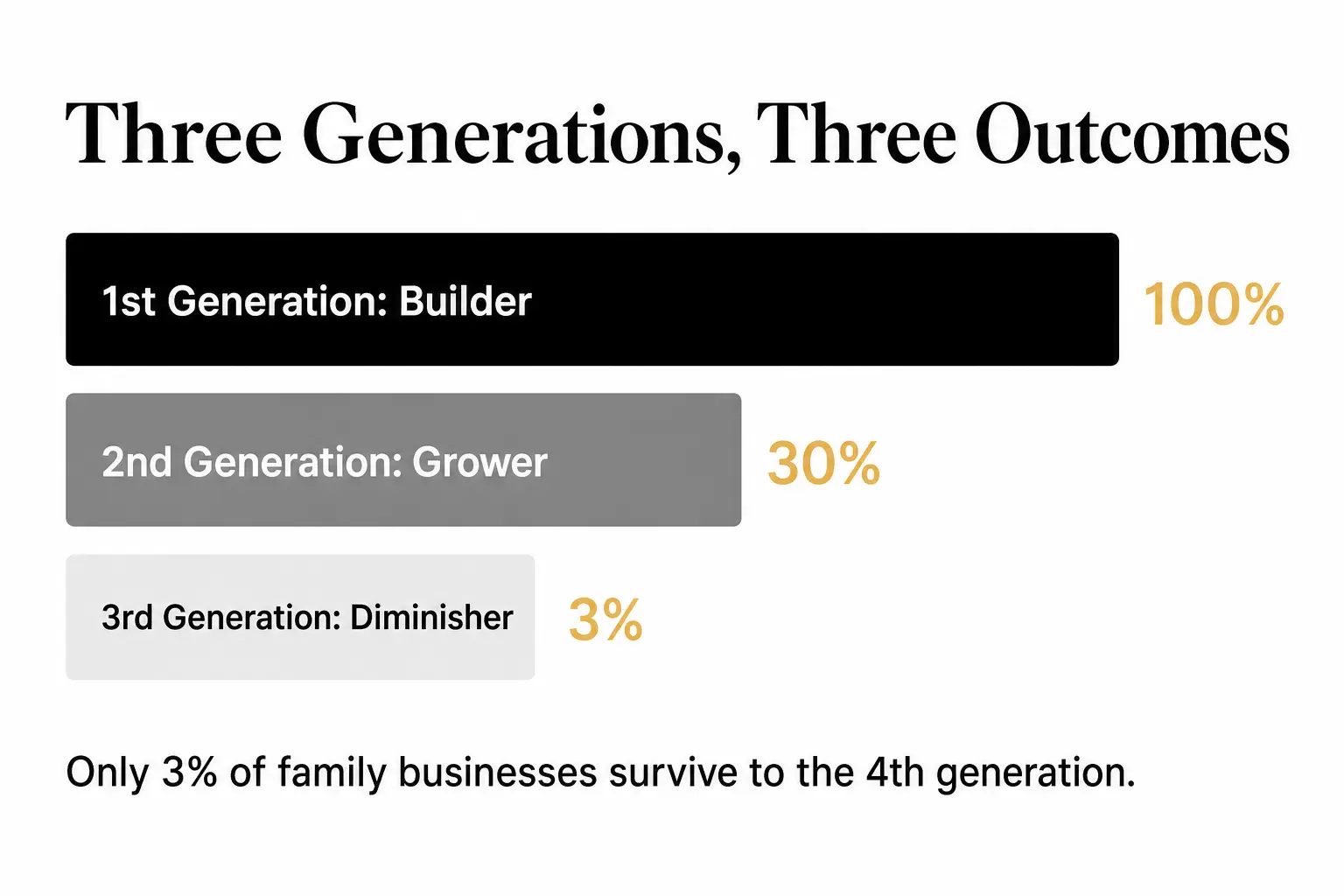
The pattern tends to follow the same shape. The first generation builds by being close to the risk. Nothing is guaranteed. Every relationship matters. Every decision has a consequence that lands fast. Out of that pressure, judgment forms. The founder does not just lead the business – they become the business. Their values set the culture. Their instincts drive strategy. Their personal relationships are the competitive advantage no competitor can copy.
The second generation grows what was built. They are close enough to the founder to absorb some of the reasoning – not all of it, but enough. When they make mistakes, they have enough context to recover.
The third generation inherits the structure but not the understanding. They are capable, often brilliantly educated. But they have been handed a vehicle without the manual for how it behaves under pressure. When things get hard – and they always do – they make decisions that feel right based on what they can see, but miss what they cannot, because no one ever explained it to them.
This is not a failure of the third generation. It is a failure of the handover.
What the founder does not realise they are hoarding
Here is something most succession conversations are too polite to say clearly.
The founder is not trying to withhold their wisdom. They genuinely intend to pass everything on. They believe they have, because they have answered every question their children ever asked.
But answering questions is not the same as transferring the operating system.
The founder’s deepest knowledge is not stored as information. It is stored as instinct. As pattern recognition. The kind of judgment that reads twenty signals at once and arrives at a conclusion that feels obvious – but cannot be explained to anyone who has not spent decades building the same pattern library.
Ask a seasoned promoter why he chose one supplier over another when the financial terms were the same. He might pause and say: “I noticed how the other man’s accountant looked at the door when we mentioned payment terms. I have seen that look before.” His son, hearing that for the first time, has no idea what to do with it.
That is the gap. Not a gap of information. A gap of lived experience that was never unpacked.
“I have joined my family business 1.5 years back, and I am learning a lot… the thing is that nobody tells you HOW decisions get made. You see the decision, but not the logic. When I try to apply the logic myself, I often get it wrong because there’s a history and context I don’t have.” – Second-generation leader, r/IndiaBusiness
That comment was one of hundreds in a thread of next-generation leaders in India sharing the same experience. They have the title. They are sitting in the chair. They are looking at the same data their parent looked at. And they are making decisions that feel reasonable in isolation but keep missing something – because the something they are missing was never handed over.
The three things that actually need to transfer
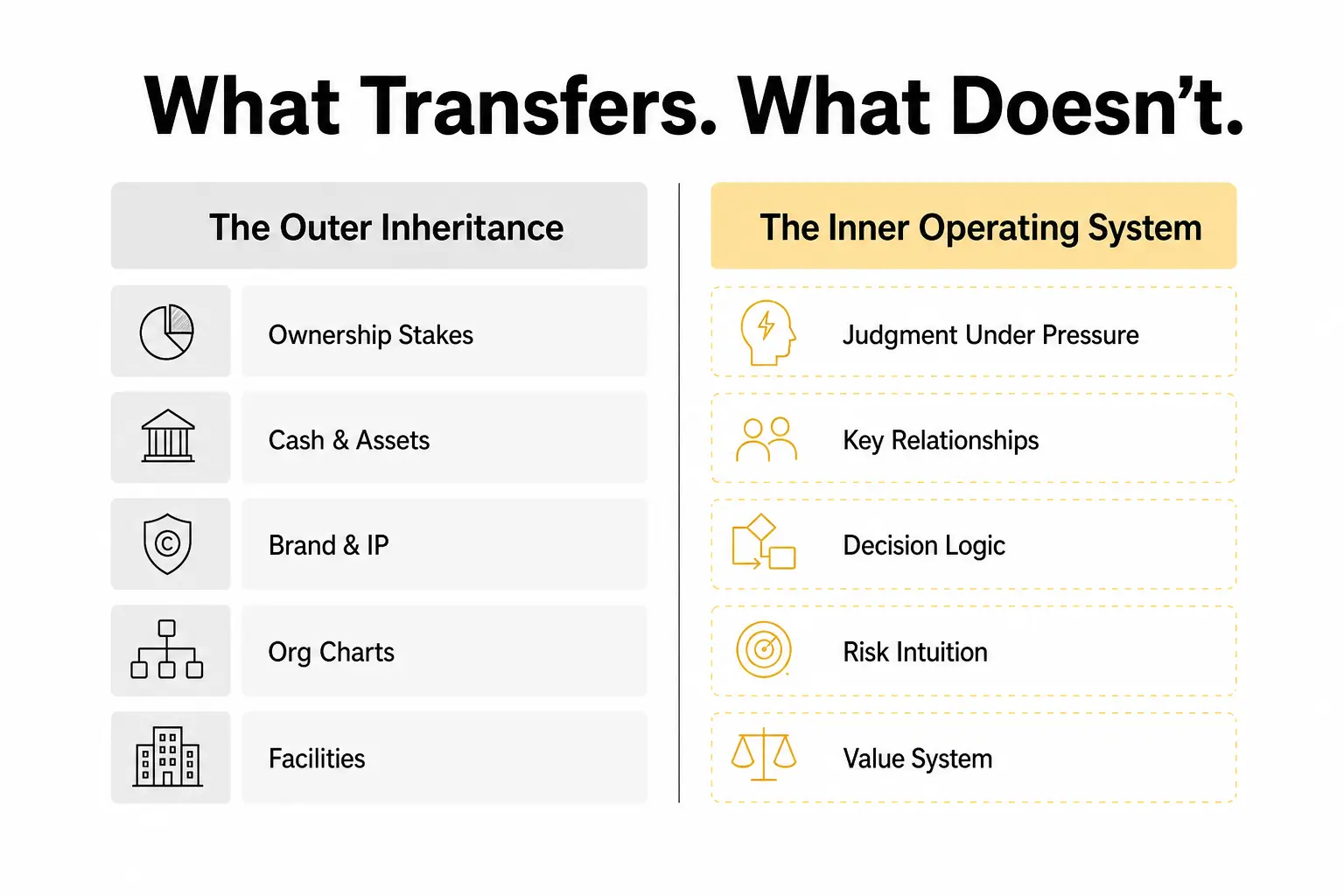
Ownership transfer is the beginning, not the end. Three deeper layers need to move across generations – and most succession plans miss all three.
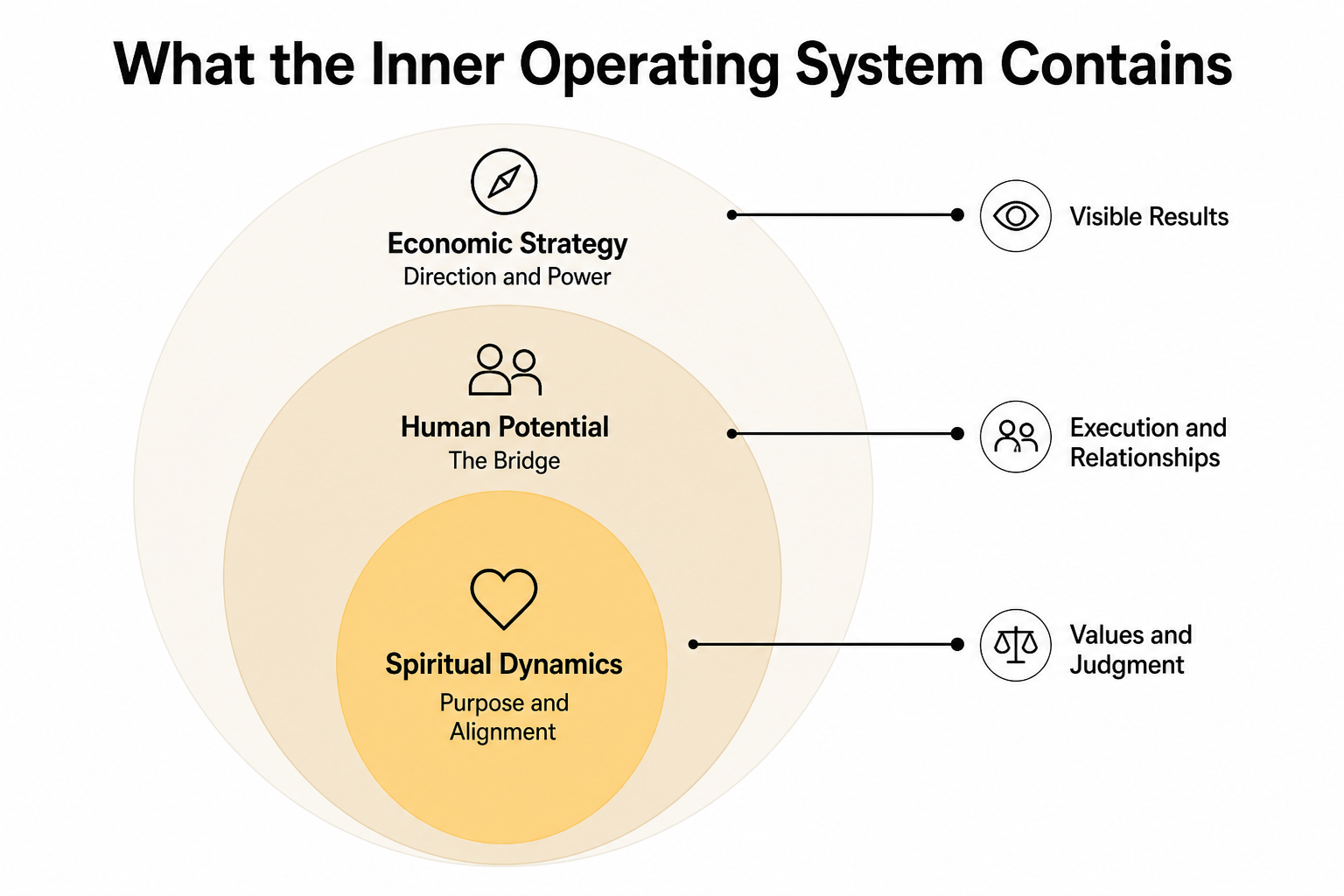
The first is the values layer – what the founder would never compromise on, regardless of the financial pressure to do so. This is the “why” behind the business. It is rarely stated out loud, because the founder never needed to say it – it was simply how they made every decision. When it is absent in the next generation, the business still makes money, but something shifts. Employees sense it. The culture drifts. Decisions that were once obvious become arguments, because the shared value that made them obvious is no longer visible to everyone.
The second is the relationships layer – the people who made the business work. In most promoter-led businesses, the promoter’s personal relationships are the competitive advantage. Key customers are loyal to the person, not the company. Suppliers give favourable terms because of decades of trust, not credit ratings. When the founder leaves and the next generation has not been properly embedded in those relationships, that capital quietly dissolves. Sometimes it takes years to show up. When it does, it looks like a business problem. It is actually a relationship problem.
The third is the strategic logic layer – not the business model itself, but the reasoning behind the major bets that built it. Why did we enter that market when we did? Why did we pass on that acquisition when everyone thought we should take it? What do we believe about where value is created in this industry? This is the layer that gets written up neatly in annual reports but never actually explained to the people who need to understand it.
Look at the contrast between Gucci and Tata. Gucci’s third generation were not incompetent – they destroyed a luxury empire because they had no shared framework for making decisions when they disagreed. Aldo’s son Paolo and his nephew Maurizio inherited authority without inheriting the logic for how to use it. The result: publicly destructive conflict, a company at negative net worth of $17.3 million by 1991, and a fire sale to Investcorp.
The Tata Group took the opposite path. The family did not insist that every next-generation member become an operator. They documented values, built proper governance, and separated ownership from management. The Tata name means something specific – consistently, across every leadership change, across generations. That meaning is the inner operating system. It survived because it was built into the institution, not left inside one person’s head.
The India-specific urgency
India’s promoter-led businesses represent over 70% of listed firms, according to PwC India. An estimated $1.5 trillion is set to move from founders to the next generation over the coming years.
And yet 67% of those businesses have no documented succession plan. Only 63% have formal governance structures.
The promoter model is India’s greatest business strength – and its biggest succession risk. The strength comes from founder-driven vision and speed. The risk is that the business is so deeply tied to one person’s character and relationships that the transfer problem is harder, not easier. The promoter’s relationships often are the business. Their reputation is the trust that holds suppliers, customers, and employees in place.
Investors have already noticed. There is a clear pattern of stock prices falling on succession announcements, even when the incoming leader looks strong on paper. What the market is pricing in is the uncertainty of whether the inner operating system has actually transferred. In many cases, that uncertainty is entirely justified.
Why the real work hasn’t started yet
Most founders believe they have transferred what matters because they have been available. They answered questions. They reviewed decisions. They were present.
But availability is not the same as transfer. And presence is not the same as passing on understanding.
The inner operating system does not move through proximity alone. It moves through something harder – through a founder being willing to make explicit what has always been implicit. To say out loud, for the first time, the reasoning that has lived entirely inside them. To explain not just what they decided, but why. Not the logic they would give a board presentation, but the real logic. The values that held. The instincts they trusted. The lines they would not cross.
That is work most founders have never been asked to do. And most succession processes never ask them.
“We didn’t write down ‘do X.’ We wrote down ‘here’s how we evaluate market risk’ or ‘here’s our philosophy on pricing.’ The next gen can apply those principles to new situations.” – Practitioner, LinkedIn thread on family business succession
That comment is rare. Most families never reach it. Not because they lack the intelligence or the intention, but because the process they are running – legal, financial, operational – was never designed to get there.
It also requires something the founder rarely anticipates needing to give up. Not just the role. The sense of being the one who knows. Many founders discover, when they begin this process honestly, that what they have been protecting is not the business. It is their identity as the indispensable one.
That discovery, if it comes, tends to be the real beginning.
The question that determines everything
Here is a simple test.
If you were to leave the business tomorrow – not to retire, but to genuinely disappear in a way that meant you could never answer another question – would the people you left behind know not just what to do, but why? Would they know what you would never compromise on? Which relationships matter most and why? The logic behind the decisions that defined the business?
For most founders, the honest answer is no.
Not because they don’t care about their legacy. Often, it is the opposite. They care so much that they have placed themselves at the centre of everything – and have never been forced to put that knowing into structures, conversations, or documents that can exist without them.
The Bhagavad Gita’s instruction – Yogastha kuru karmani – is translated as “be established in equanimity, and then act.” I believe it is also a guide for succession. Know what you stand for. Understand why you do what you do. And then, from that clarity, do the work of transferring it – before it is too late.
The question is not whether you have a succession plan. The question is whether your succession plan contains you – your actual reasoning, your values under pressure, your private logic for every public decision.
If it does not, you have organised a handover. You have not built a legacy.
About the author
Known as ‘The Conscious Profitability Man,’ Sandeep Amar Guppta is a keynote speaker, author, and creator of The S.H.E. Framework. With over 40 years’ experience, he has the rare gift of making the deep practical, the complex simple, and the spiritual profitable – a message he has brought to Oxford University, the Science of Consciousness Conference, the ISUD World Congress, and corporate stages across continents.
He helps leaders bring spirituality and money together by upgrading what he calls the Inner Operating System: the invisible software beneath every visible result. His conviction is simple. Profit and spiritual dynamics were never meant to be separate, and the organisations that last are those that hold both.
Sandeep is a Fellow Chartered Accountant with a postgraduate diploma in Theology. He also holds certifications in interpersonal neurobiology and design thinking. He chairs the Professional Speakers Summit (PSS) for its 2027 edition.
Here, he writes for leaders who want to build organisations that last and leave legacies that matter.
Why do most family businesses fail to survive to the third generation?
Only 30% of family businesses survive into the second generation and just 12% reach the third. The most common reason isn’t a lack of strategy or capital – it’s that the founding generation’s decision-making logic, values, and key relationships were never deliberately transferred. The business passes; the operating system that built it does not. Sandeep Amar Guppta’s work on the inner operating system addresses exactly this gap.
What is the difference between succession planning and wisdom transfer?
Succession planning typically covers the outer system: legal ownership, share transfer, org structure, and governance. Wisdom transfer covers the inner operating system – the judgment the founder uses under pressure, the logic behind strategic bets, the values that shape culture, and the relationships with key customers and suppliers that took decades to build. Most succession plans do the first. Almost none do the second, which is why wealth erodes across generations even when ownership formally transfers.
How can a founder transfer their decision-making logic to the next generation?
The founder needs to make explicit what has always been implicit – not just the decisions they made, but the reasoning underneath them. The values that held under pressure. The instincts they trusted. The lines they would not cross regardless of the financial incentive. This is not a document. It is a process, and it takes time. Most succession plans are designed around legal and financial transfer; they were never built to carry this kind of knowledge. Sandeep Amar Guppta works with founding families on exactly this layer of the handover.
What does India’s $1.5 trillion wealth transfer challenge mean for promoter-led businesses?
India’s promoter-led businesses represent over 70% of listed firms, and an estimated $1.5 trillion is set to transfer to the next generation in the coming decades. Yet 67% of these businesses lack a documented succession plan, and formal governance structures exist in only 63% of them. The promoter’s personal relationships and judgment often are the business – when they leave without transferring this inner operating system, investor confidence, culture, and strategic clarity all erode simultaneously.
What does an effective succession plan actually need to contain?
Beyond legal and financial documentation, an effective succession plan needs to capture the founder’s mental models – how they evaluate risk, which relationships matter and why, what they would never compromise on, and the reasoning behind the major strategic bets that defined the business. It should also include a phased transition period where the next generation takes on increasing responsibility while the founder is still available to explain, not override. The plan is not a document. It is a multi-year process of deliberate knowledge transfer. Sandeep Amar Guppta works with promoter families to design this process.