Summary
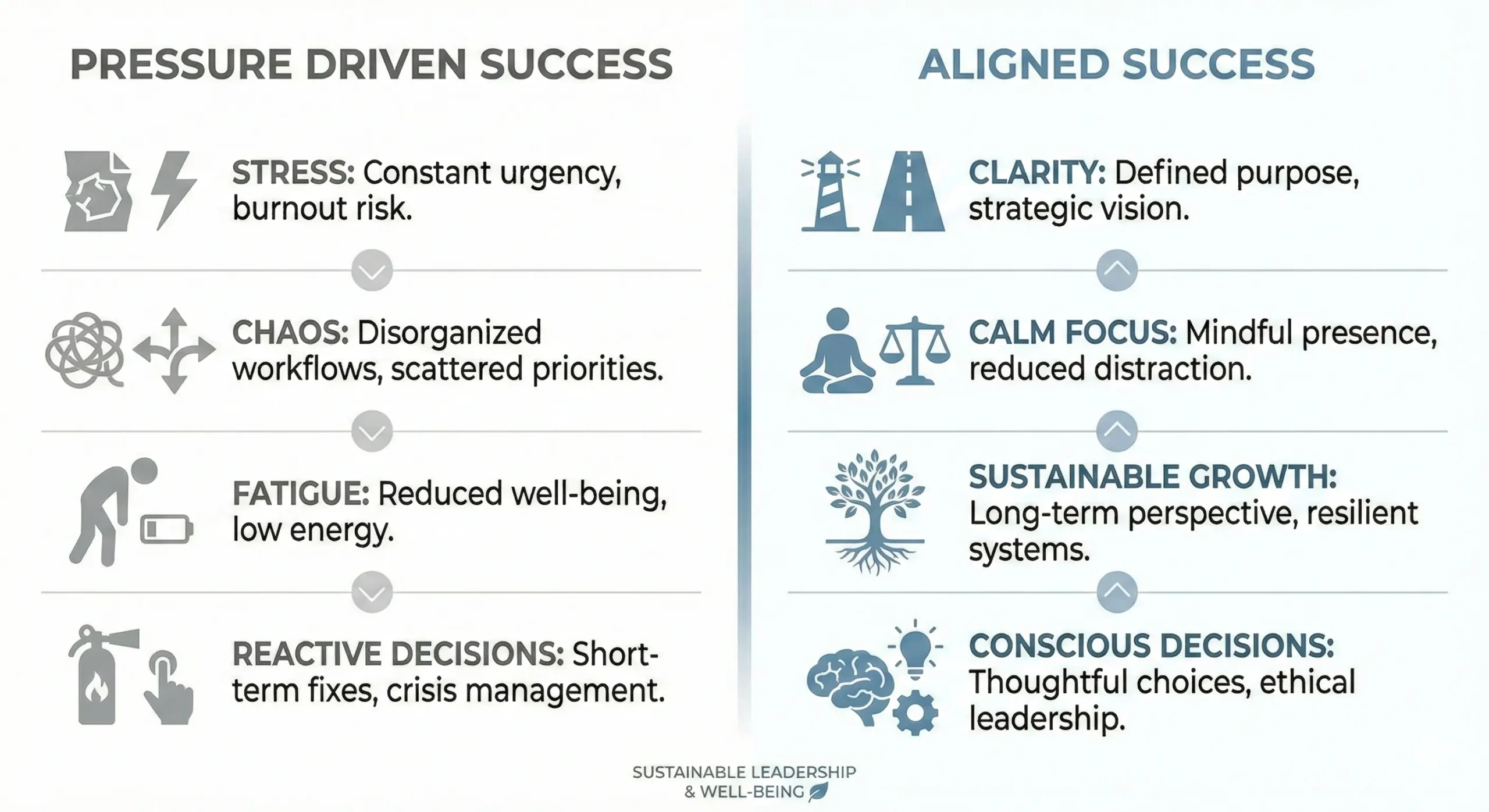
Inner peace is not a soft or abstract concept in business. It is a practical performance multiplier. When leaders operate from inner calm rather than pressure, their decision quality improves, emotional reactivity reduces, and execution becomes clearer.
Inner Peace Is a Performance Multiplier
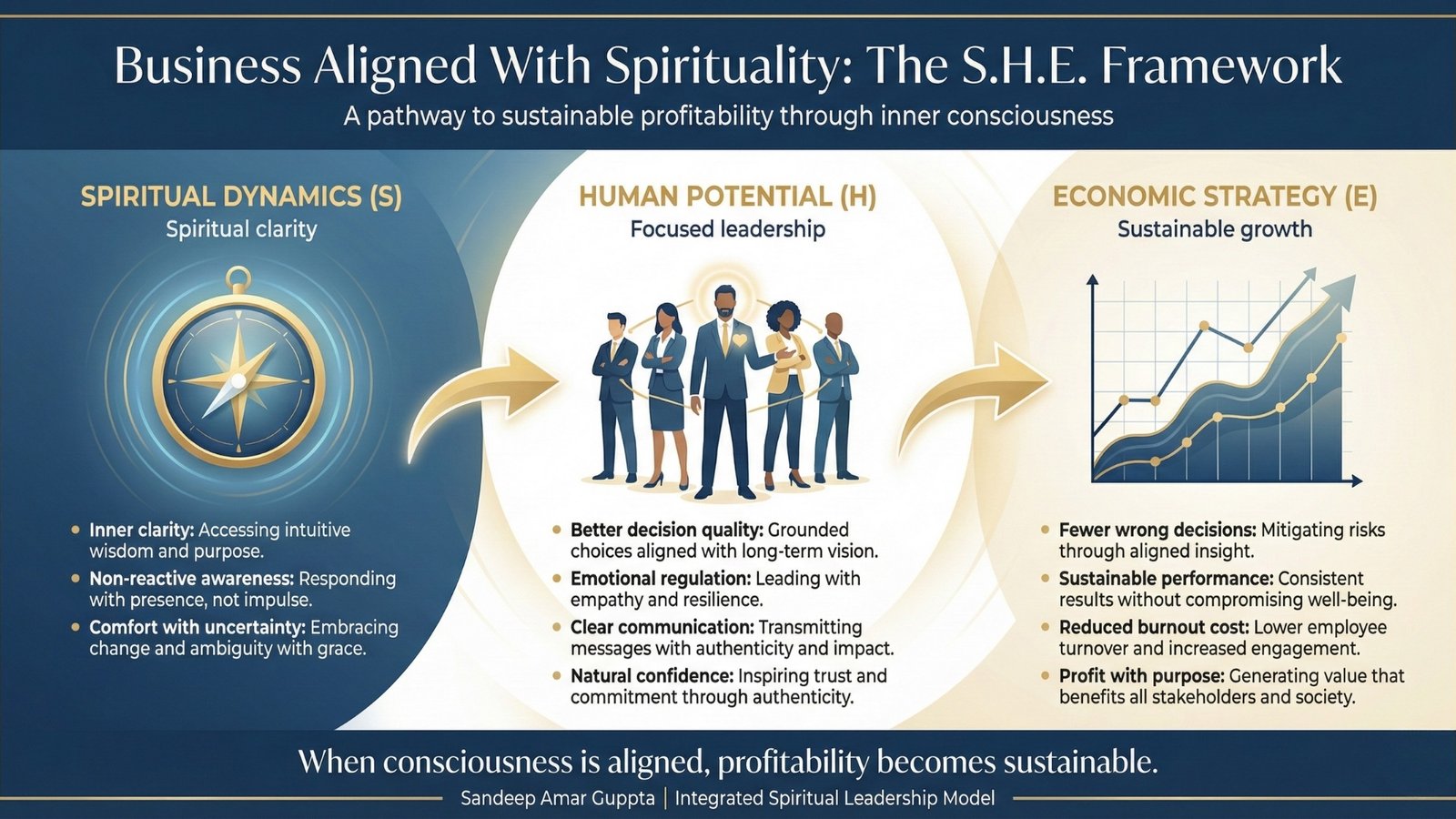
In S.H.E. terms, inner peace is not a “nice feeling.” It is Spiritual Dynamics stabilising the inner operating system so Human Potential can function at its best and Economic Strategy can translate clarity into consistent outcomes.
Business aligned with spirituality focuses on stabilizing the inner operating system of leaders so human potential can express fully and economic outcomes improve naturally. Conscious leadership integrates inner clarity with strategy, enabling profitability with purpose, resilience under pressure, and sustainable long-term growth.
Introduction: The Misunderstood Role of Pressure
Most leaders are taught that pressure sharpens performance.
Deadlines create urgency.
Stress fuels ambition.
Tension keeps people driven.
Yet quietly, many successful founders and senior leaders sense something is off. They achieve results, but at a cost they cannot always name. Decision fatigue increases. Relationships strain. Clarity disappears exactly when stakes are highest.
The problem is not effort.
It is inner friction.
From the S.H.E. Framework lens: when pressure becomes the primary fuel, Economic Strategy starts running without enough Consciousness (S) and without understanding the human mechanism (H). That is why the same hard work starts producing diminishing returns.
What if pressure does not improve performance at all?
What if it actually narrows intelligence?
This is where business aligned with spirituality begins to make sense, not as belief, but as function. Inner peace does not slow leaders down. It removes unnecessary inner noise. And when that noise reduces, performance does not decline. It multiplies.
This is the space where human centricity and profitability stop being opposites and begin to reinforce each other because S supports H, and H makes E sustainable.
The Core Insight: Why Calm Outperforms Pressure
Modern leadership culture assumes stress equals seriousness.
But stress does something subtle and dangerous. It contracts perception.
When the nervous system is under pressure, leaders may act faster, but they see less. Judgment narrows. Listening weakens. Emotional reactivity increases. The result is speed without direction.
In S.H.E. language: pressure hijacks Human Potential (H) thoughts become rushed, emotions become reactive, habits become impulsive. And then Economic Strategy (E) becomes force-driven instead of clarity-driven.
Inner peace works differently.
A calm inner state expands awareness. Leaders see options others miss. They respond rather than react. Decisions become cleaner, not slower.
This is not philosophy. It is lived performance reality. It’s the difference between trying to “fix results” versus stabilising the inner operating system that produces results.
In the Ramayana, Lord Rama faces moments of extreme uncertainty, exile, loss, and war. What distinguishes him is not aggression or urgency, but steadiness. Even in conflict, his clarity remains intact. His actions are decisive, but never impulsive. That inner composure becomes the source of trust, loyalty, and sustained leadership.
The lesson is timeless. Calm does not reduce action. It improves the quality of action because S stabilises H, and H improves E.
Applying the S.H.E. Framework to Conscious Performance
S: Spiritual Dynamics
Spirituality in business is often misunderstood as belief or morality. In reality, it is about how a leader relates to uncertainty.
Inner peace at this level means reduced inner conflict.
It means accepting uncertainty without panic.
It means non-reactive awareness under pressure.
In other words: you cannot “repair” performance without understanding the engineering. Spiritual Dynamics is the part of the human engineering that brings awareness, presence, and perspective the stabiliser of the inner operating system.
When leaders are internally anchored, they are not hijacked by fear, ego, or urgency. This creates emotional stability and psychological safety, first within themselves and then across their teams.
This is the foundation of business aligned with spirituality S is not decoration; S is the stabilising force.
H: Human Potential
When the inner system is calm, human potential becomes accessible.
Cognitive bandwidth increases.
Listening deepens.
Emotional regulation improves.
Confidence becomes natural rather than forced.
This is the “engineering” part leaders miss. Human Potential explains how thoughts, emotions, habits, and reactions actually work. And it explains why pressure does not always sharpen performance—it often triggers reactivity.
Many high performers already have skills and experience. What blocks them is inner noise. Overthinking, fear of outcomes, and constant mental pressure prevent access to their own intelligence.
Inner peace removes interference. It allows leaders to use what they already know, more effectively and more consistently. That is H functioning in its full expression because S has stabilised the inner system.
E: Economic Strategy
Calm leadership directly affects economic outcomes.
Leaders operating from clarity take fewer wrong decisions.
This reduces the hidden costs of stress-driven leadership: attrition, rework, conflict, and strategic drift.
Profitability improves not through force, but through coherence.
This is the integrated spiritual leadership model in action:
Spiritual Dynamics (S) gives clarity and presence,
Human Potential (H) makes thinking and behaviour stable,
and Economic Strategies (E) converts that clarity into sustainable action, money decisions, and impact.
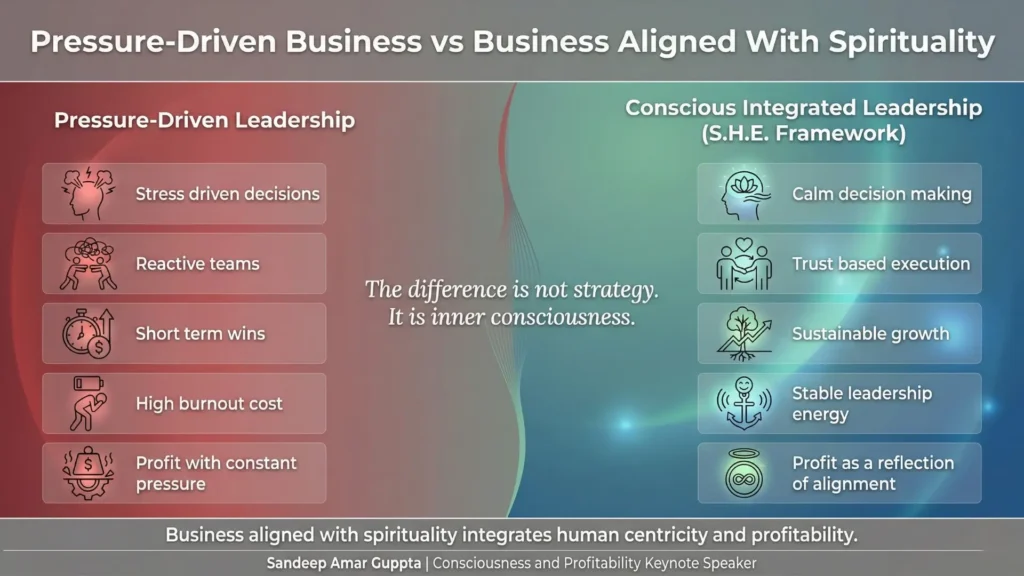
A Simple Comparison: Pressure-Driven vs Peace-Driven Leadership
| Dimension | Pressure-Driven Leadership | Peace-Driven Leadership |
| Decision Quality | Reactive, risk-heavy | Clear, proportionate |
| Team Trust | Fear-based compliance | Psychological safety |
| Energy Usage | High burn, low recovery | Sustainable performance |
| Profitability | Short-term spikes | Long-term stability |
| Leadership Presence | Tense, controlling | Calm, authoritative |
This contrast explains why human centricity and profitability are not competing goals. They are causally linked.
From the S.H.E. lens: when S and H are stable, E stops becoming a struggle. Effort reduces, clarity increases, and results become more repeatable.
A Realistic Leadership Scenario
Consider a founder scaling a fast-growing company.
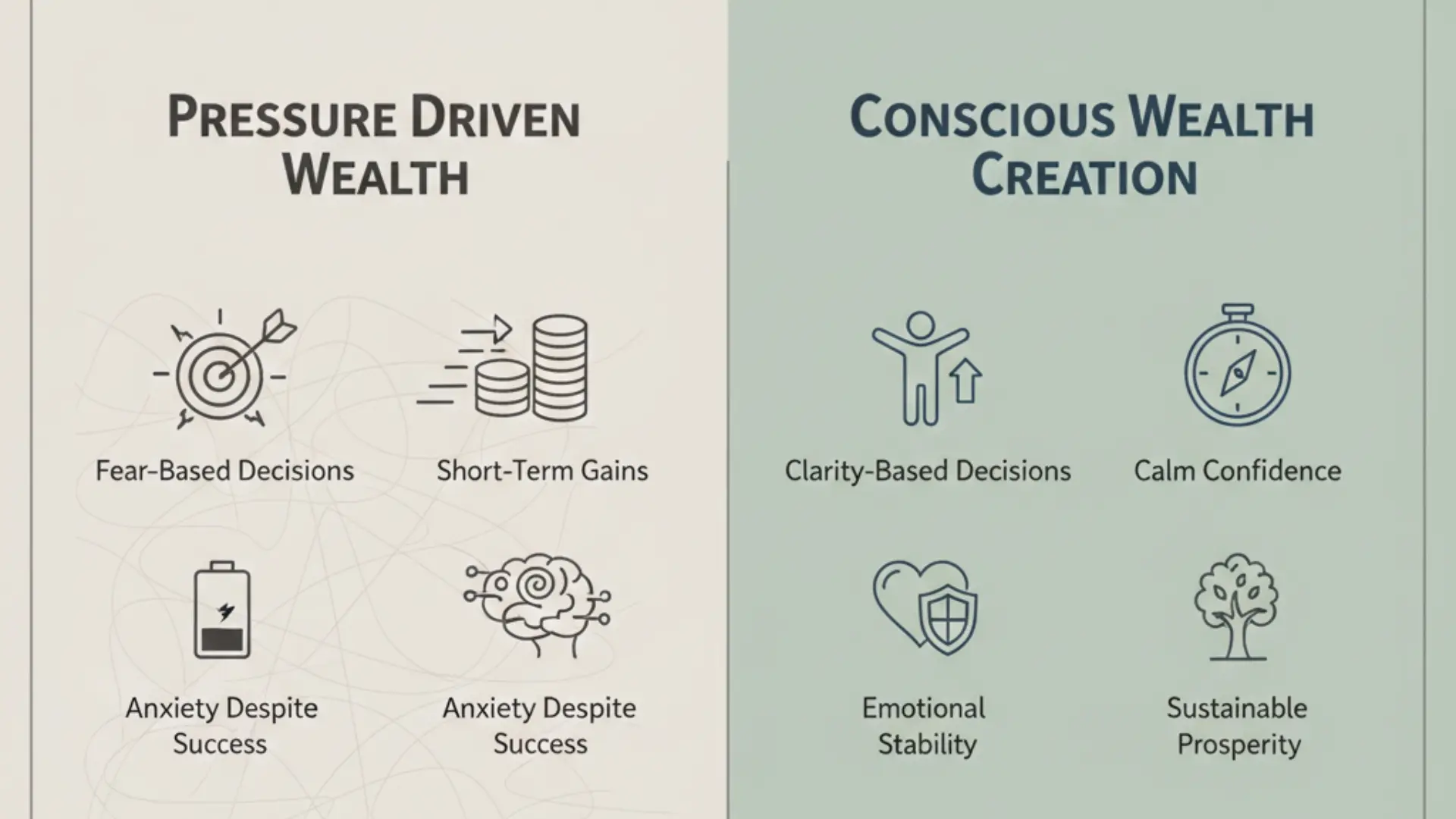
Before the shift, their days are full of urgency. Every decision feels critical. Meetings are rushed. Sleep is shallow. The mind is constantly racing ahead. Despite success, there is an undercurrent of anxiety.
Then something changes. Not the workload, but the inner relationship with it.
The founder learns to stabilize internally before responding. They pause before deciding. Emotional reactions soften. Conversations become more grounded.
Nothing slows down externally.
Yet decisions improve.
Conflicts reduce.
The team feels safer and more accountable.
This is not transformation theatre. It is subtle. But the effects compound.
That is the performance multiplier.
In S.H.E. terms: S stabilises, H opens up, and E becomes coherent—and that coherence compounds results.
Practical Insights for Leaders
• Calm improves speed by removing second-guessing.
• Pressure narrows judgment even in experienced leaders.
• Rest without inner alignment does not resolve burnout.
• Presence builds trust before competence is proven.
• Inner peace preserves energy and directs it more effectively.
These are not techniques. They are observations from lived leadership experience.
And they are also the visible outcomes of S.H.E alignment: when the inner operating system is aligned, performance becomes cleaner, not harder.
Human Centricity and Profitability: The False Divide
Many organizations still believe caring for people comes at the expense of results.
The reality is the opposite.
Leaders who demonstrate spiritual attributes in their purpose, thoughts, and actions create environments where people think clearly and act responsibly. That directly impacts execution quality and financial outcomes.
This is why organizations increasingly invite a consciousness and profitability keynote speaker who understands both inner dynamics and economic realities.
The future belongs to leaders who integrate, not compartmentalize.
That is the S.H.E. Framework message: Spiritual Dynamics without Human Understanding becomes vague. Human Potential without Economic Strategy becomes impractical. Economic Strategy without Consciousness becomes destructive. Only integration creates sustainable growth.
A Quiet Close
Inner peace is not withdrawal from ambition.
It is freedom from inner friction.
Business aligned with spirituality is not about believing differently. It is about operating differently.
This is the work Sandeep Amar Guppta focuses on through the S.H.E. Framework. Helping leaders stabilize their inner world so human potential expresses fully and economic strategy becomes sustainable.
If this perspective resonates, it may be worth exploring further.
Clarity changes everything.
1. What does “business aligned with spirituality” actually mean?
Business aligned with spirituality means operating from inner clarity rather than inner conflict. It does not involve religion or belief systems. Instead, it focuses on stabilizing the inner state of leaders so decisions, relationships, and strategies are driven by awareness, presence, and coherence. When inner alignment improves, human potential expresses fully and economic outcomes become more sustainable.
(S.H.E. lens: S stabilises the inner operating system → H functions at its best → E becomes coherent.)
2. How does inner peace improve performance in leadership roles?
Inner peace reduces mental noise and emotional reactivity, which directly improves judgment, decision speed, and communication quality. Calm leaders see options more clearly, respond rather than react, and conserve energy over time. This leads to fewer wrong decisions, stronger teams, and consistent execution, making inner peace a genuine performance multiplier.
(S strengthens H, and H upgrades the quality of E.)
3. Is conscious leadership practical in high-pressure business environments?
Yes. Conscious leadership is most valuable under pressure. High-stakes environments amplify inner instability, which often leads to poor decisions. Conscious leadership helps leaders remain centered amid uncertainty, allowing them to think clearly, regulate emotions, and act decisively. This makes it highly practical, not idealistic, especially in complex and fast-changing business contexts.
(S under pressure protects H, so E doesn’t become destructive.)
4. How does the S.H.E. Framework connect spirituality with profitability?
The S.H.E. Framework integrates Spiritual Dynamics, Human Potential, and Economic Strategy. Spiritual Dynamics stabilizes the inner operating system. Human Potential becomes accessible through clarity and emotional regulation. Economic Strategy benefits from better decisions, trust, and sustainable performance. Profitability improves not by force, but by reducing internal friction and improving execution quality.
(S + H + E together = purpose + profit + sustainable growth.)
5. Why are organizations inviting consciousness and profitability keynote speakers today?
Organizations are recognizing that burnout, poor decisions, and disengagement are not skill problems but inner stability problems. A consciousness and profitability keynote speaker addresses this gap by linking inner clarity with real business outcomes. This approach supports human centricity while strengthening performance, trust, and long-term economic value.
(Because modern growth demands integration, not compartmentalisation.)