Why family businesses fail across generations
August 1, 2026
By Sandeep Amar Gupta and Team


Hi! I'm Sandeep Amar Gupta
Helping harness Consciousness (Inner Operating System) for sustainable results, income & peace.
When you hand over the business, you think you’re done. You’re not even halfway there.
TL;DR
Most family businesses treat succession as a legal exercise. Sign the papers, transfer the shares, update the org chart and call it done. But what actually built the business wasn’t the structure. It was the judgment, the values, and the decision-making logic inside the founder’s head. None of that transfers automatically. Inheritance hands over the keys. Succession hands over the knowledge of how to use them. Most families only ever do the first one.
The moment most families think they’re done
Your father built the business over 30 years. Now it’s time to hand it over. The meetings are scheduled. The lawyer has the documents ready. The shares are being registered in your name. You feel like the job is done.
It isn’t.
What just happened was inheritance. And inheritance is the easy part. It is the part a lawyer can handle, the part a document can record. It has been happening in family businesses for centuries. The paperwork gets filed. The business formally changes hands. But the business didn’t really change hands. Not yet.
What inheritance actually transfers and what it doesn’t
Inheritance is about ownership. It answers one question: who does this legally belong to now?
It transfers what you can see. The shares and equity get documented and registered. The physical assets, property, machinery, and inventory pass on. The org structure gets updated with new charts and new titles. Legal authority, the right to make decisions, formally shifts.
What it doesn’t transfer is the reason certain decisions were made. The judgment behind them. The 30 years of learning that shaped how your father evaluated risk, managed relationships, and knew in his gut when to say yes and when to walk away.
“The next generation inherits the outer structure. They rarely inherit the inner software that ran it.” – Sandeep Amar Guppta
That inner software is exactly what succession planning is supposed to carry forward. And most families never do it.
Why the difference shows up slowly, then all at once
The gap between inheritance and succession doesn’t appear on day one. The business keeps running. Revenue comes in. Things look fine on the surface.
The damage shows up quietly over time. At first, the structure is intact, the next generation is capable, and nobody sees a problem. Before long, decisions that used to be obvious become arguments. What felt like common sense to the founder feels like unnecessary risk to the son. What the founder called a principle, the daughter calls stubbornness. Nobody agrees, because nobody ever explained the why underneath the decisions. Over time, the wealth may remain, but the culture begins to shift. Employees feel something different. Customer relationships are handled differently. The business survives, but something the founder built has quietly gone.
This is not a story about incompetence. Research consistently shows that only 30% of family businesses survive to the second generation, and just 12% reach the third. Not because the next generation lacks talent, but because the operating logic was never passed on.
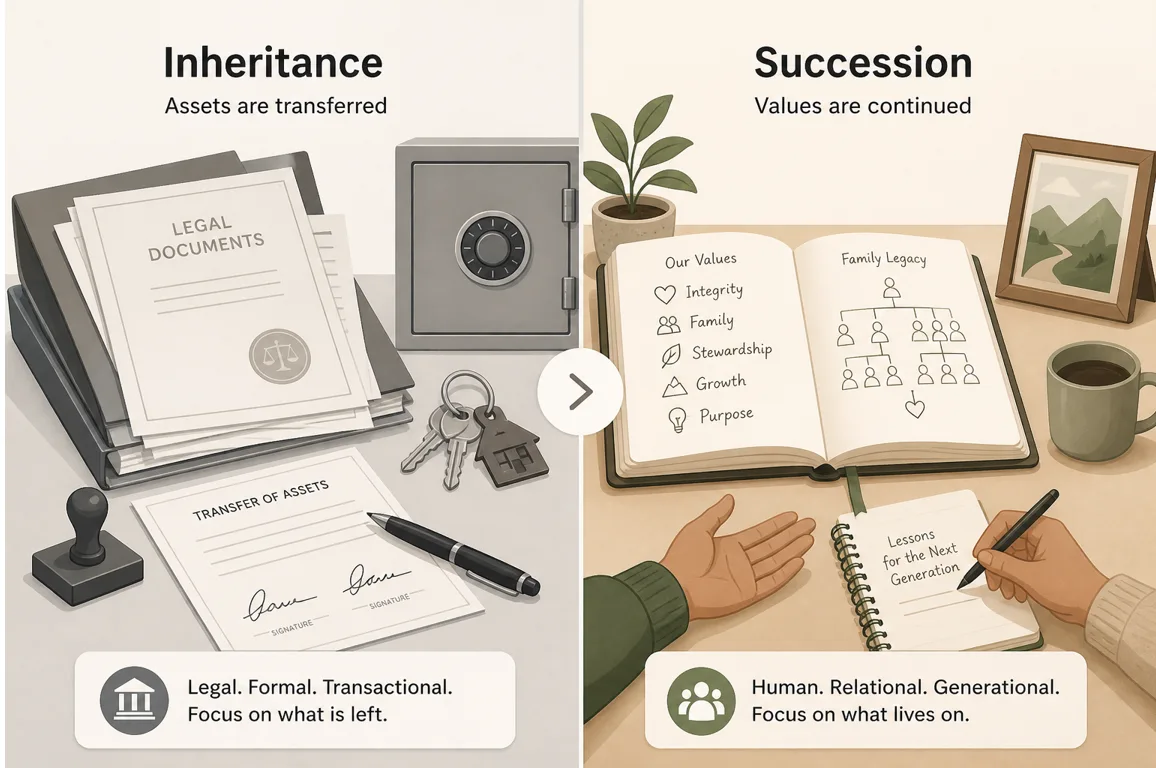
Inheritance transfers what’s visible. Succession transfers what actually built it.
What succession planning is actually for
Succession planning is not a document. It is not a one-time meeting with an accountant. It is a deliberate process of making the implicit explicit, of taking what lives inside the founder’s head and putting it somewhere the next generation can actually use.
It means the founder sitting down and answering questions they have never had to answer out loud before.
- How do you evaluate a risk? Not the outcome, but the thinking behind it.
- Why does a certain relationship matter beyond what the contract says?
- What would you never do even if the money was good?
- What did you learn from the failures that never made it into the annual report?
- What is this business really about, underneath the revenue and the profit and loss?
It also means time. Real time where the founder is still present when decisions come up, not to override, but to explain. Most succession plans are designed by accountants and lawyers. They are thorough and professional and they miss all of this completely.
The Gucci lesson and the Tata lesson
The contrast between two well-known families makes this concrete.
Gucci’s third generation destroyed a luxury empire, and they weren’t incompetent. They destroyed it because they had no shared framework for making decisions when they disagreed. Maurizio Gucci and his cousins had inherited authority without inheriting the logic for how to use it. The result was public conflict, a company at negative net worth by 1991, and eventually a fire sale.
The Tata Group took the opposite path. The family separated ownership from management, documented their values, and built governance structures that didn’t depend on any one person’s judgment surviving them. The business outlasted the founder by design. The difference wasn’t strategy or talent. It was whether the inner operating system was deliberately transferred or just assumed to pass on by itself.
The question worth asking before the papers are signed
Most founding families believe they have done succession planning when what they have actually done is inheritance planning. These are not the same thing, and the gap between them is where most family businesses quietly begin to fail.
A few honest questions worth sitting with before the handover happens.
- If your successor had to make a difficult decision tomorrow without calling you, would they know what you would consider non-negotiable?
- Have you ever explained, out loud, why your most important relationships matter and not just that they matter?
- Does the next generation understand what you would never compromise on, even under real financial pressure?
If the answers are unclear, the papers being signed are inheritance. Not succession. That gap is worth closing before the handover, not after.
About Sandeep Amar Guppta
Known as ‘The Conscious Profitability Man,’ Sandeep Amar Guppta is an International keynote speaker, author, and creator of The S.H.E. Framework. He helps founders, business families, and leadership teams build organizations that outlast them by aligning (S) Spiritual Dynamics, (H) Human Potential, and (E) Economic Strategies through mastery of their Inner Operating System.
A Fellow Chartered Accountant with a postgraduate diploma in Theology, he is also certified in Design Thinking and Interpersonal Neurobiology. Combining a deep understanding of both the human and economic dimensions of business, he has spoken at Oxford University, the Science of Consciousness Conference, the ISUD World Congress, and global corporate forums.
He writes for leaders who want to build conscious profitability, enduring organizations, and legacies that matter.
Work with Sandeep: https://sandeepamarguppta.com/work-together
Frequently Asked Questions
What is the difference between inheritance and succession?
Inheritance is the legal transfer of ownership, shares, assets, and authority from one generation to the next. Succession is the transfer of the judgment, values, and decision-making logic that built the business. Both matter. But most families only do the first, which is why wealth and businesses erode across generations even when ownership formally transfers.
Why do most family businesses not survive to the third generation?
Only 30% of family businesses survive to the second generation, and 12% to the third. The most common cause isn’t a lack of strategy or capital. It’s that the founding generation’s operating logic was never deliberately transferred. The business passed. The understanding of how to run it didn’t.
When should succession planning start?
Earlier than most families think. By the time a founder is ready to step back, the window for real wisdom transfer has often narrowed significantly. The process works best when it starts while the founder is still actively running the business, so the next generation can observe, ask questions, and take on increasing responsibility with the founder there to explain rather than override.
What does real succession planning involve?
Beyond legal and financial documentation, it means capturing the founder’s mental models. How they evaluate risk, which relationships matter and why, what they would never compromise on, and the reasoning behind the major strategic decisions that defined the business. It is a multi-year process of deliberate knowledge transfer. Sandeep Amar Guppta works with promoter families to design exactly this process.
Is it too late to do succession planning after the handover has already happened?
Not entirely, but it is harder. The founder’s authority has shifted, the next generation is already making decisions, and the gaps only become visible under pressure. The most effective work happens before the handover. If it has already happened, the focus shifts to building shared frameworks and explicit values that the next generation can use going forward.

More Like This

Succession in Family Business: How to Hand Over Control Step by Step
September 23, 2026

How to Disagree in a Family Business Without Hurting the Family
September 16, 2026

Can Conscious Leadership Really Drive Business Profitability?
August 27, 2026
Succession in Family Business: How to Hand Over Control Step by Step
September 23, 2026