Most founders spend years optimising for exit – and regret it. Here’s why building for legacy is both the harder and the better choice.
TL;DR
Most founders say they’re building something that lasts. But when every decision is made to look good to a potential buyer – who to hire, what to build, how to talk about the culture – you’re not building a legacy. You’re building an asset to sell. The surprising truth: founders who build genuinely for legacy tend to get better outcomes anyway, whether they sell or not. The thing that makes the difference isn’t a new strategy. It’s the quality of thinking behind every decision.
The question founders almost never ask out loud
There’s a conversation that happens in boardrooms and on founder retreats, usually in a quiet moment nobody planned for. It goes something like this:
We built something real here. Is this actually going somewhere? Or are we just optimising to sell?
Most founders don’t ask it out loud, because it feels like a betrayal of their investors or board. Selling is assumed to be the destination. The whole startup vocabulary – runway, liquidity event, term sheet – is built around an endpoint, not an endgame.
But research from the Exit Planning Exchange shows the majority of founders who sell regret it within the first year. And it’s almost never about the money. It’s about losing the company that was their identity, watching a new owner undo the culture they spent years building, or simply missing the work they were doing before the deal.
“When it comes time to sell your business, I think it’s important to think about who I’m selling to and what legacy I want to leave.” – Marc J Bernstein, LinkedIn
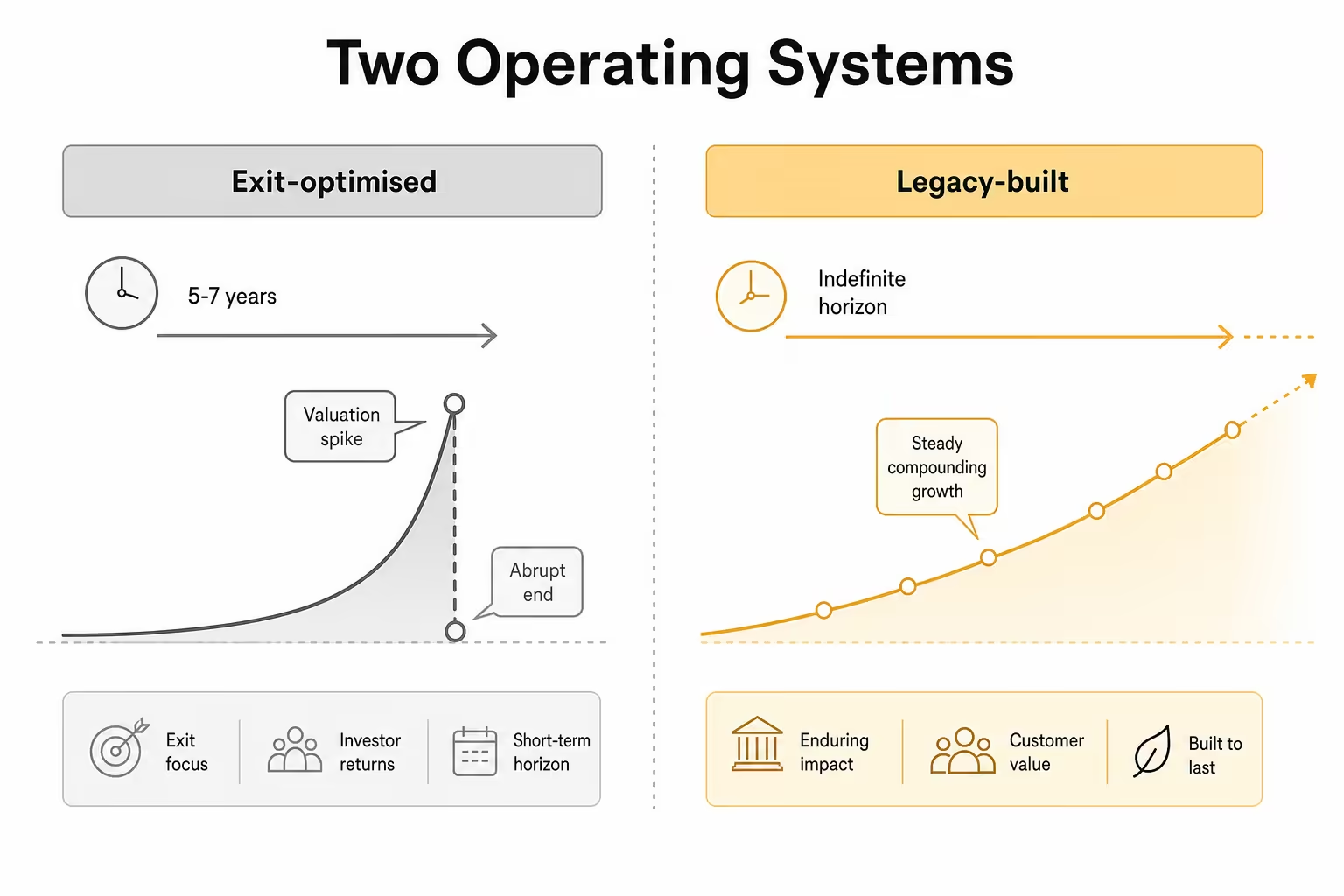
This isn’t an argument against selling. Some businesses are built to be acquired, and there’s nothing wrong with that. But it is an argument for being honest, early, about which one you’re actually building – because the two paths look almost identical at the start and diverge sharply over time.
What building for exit actually looks like
Building toward a sale isn’t cynical. Most founders who do it genuinely believe the mission and the exit aren’t in conflict. The tension is subtler.
It shows up in decisions that each seem reasonable but add up to a particular shape over time:
You hire to a model that looks good on paper, not to what the work actually needs.
Your product roadmap drifts toward what buyers want to see, not what customers are asking for.
Culture becomes something you measure and report, rather than something the company actually believes in.
Decisions that would pay off in five years get pushed back because they don’t help this quarter’s numbers.
None of this is dishonest. These are normal responses to the pressure of building toward a sale. The problem is that they accumulate. By the time most founders notice what they’ve built, they’re already in the handover period after selling, wondering why nothing feels right.
What separates the founders who actually build legacies
Building for legacy is harder than it sounds. Not because the ideas are complicated, but because every incentive structure around a founder is pulling in the opposite direction. Investors want returns on a timeline. Boards want metrics. The pressure to show results this quarter is constant.
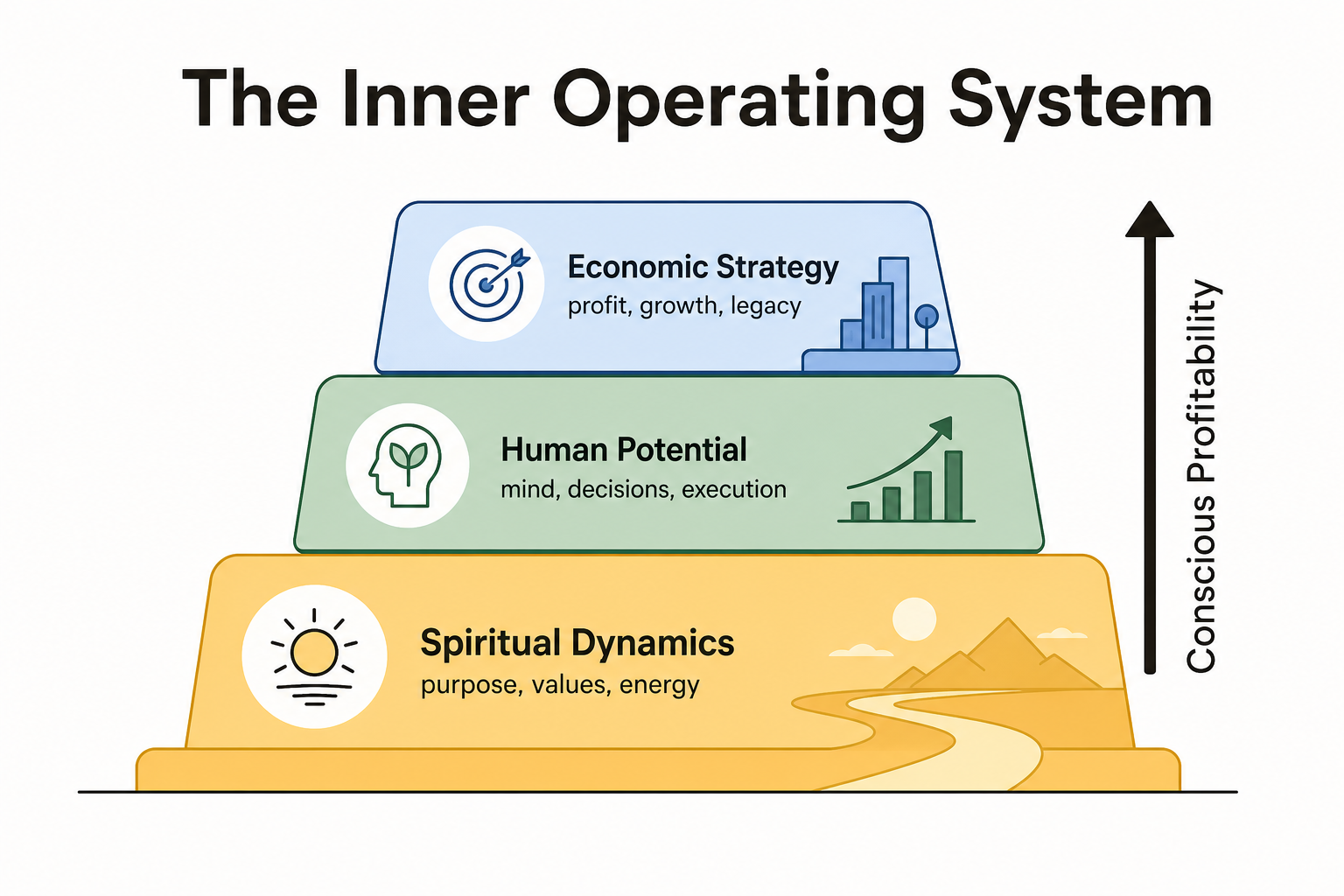
What Sandeep Amar Guppta has found, across 45 years of working with founders and organisations, is that the difference between companies that last and companies that just grow isn’t strategy. It’s something he calls the Inner Operating System – the thinking, values, and clarity sitting behind every decision a founder makes.
Strategy, team, product: those are visible results. The Inner Operating System is what produces them.
The founders who end up building genuine legacies aren’t following a different playbook. They’re operating from a different place entirely – one most leadership conversations never quite get to. And it’s not something you can read your way to, or hire a consultant to install. It has to come from somewhere real.
The $630M to $1.47B shift
A client came to Sandeep Amar Guppta with a sales book of $630M. The strategy was sound. The team was strong. By every external measure, things were working.
Twelve months later, the enterprise value had reached $1.47B – a 133% increase.
No new strategy. No product pivot. No restructuring.
What changed was the clarity of the thinking behind every decision. The alignment between what the company said it stood for and how it actually operated day to day. When those line up, work stops leaking energy. Decisions get made faster. Teams take real ownership. The results compound.
This is what Sandeep means by conscious profitability: profit isn’t what you trade against deeper values. It’s what happens when the values are genuinely in place.
The structure behind this is The S.H.E. Framework – Sandeep’s model for how Spiritual Dynamics, Human Potential, and Economic Strategy work together. Not as separate priorities to balance, but as a single system. When one is missing, the other two eventually break down.
The S.H.E. Framework – Spiritual Dynamics, Human Potential, Economic Strategy, as taken from Sandeep Amar Guppta
Most leadership frameworks address one or two of these. The reason the $630M to $1.47B shift happened – and why it held – is that all three were aligned at once.
The Four Laws of Conscious Profitability
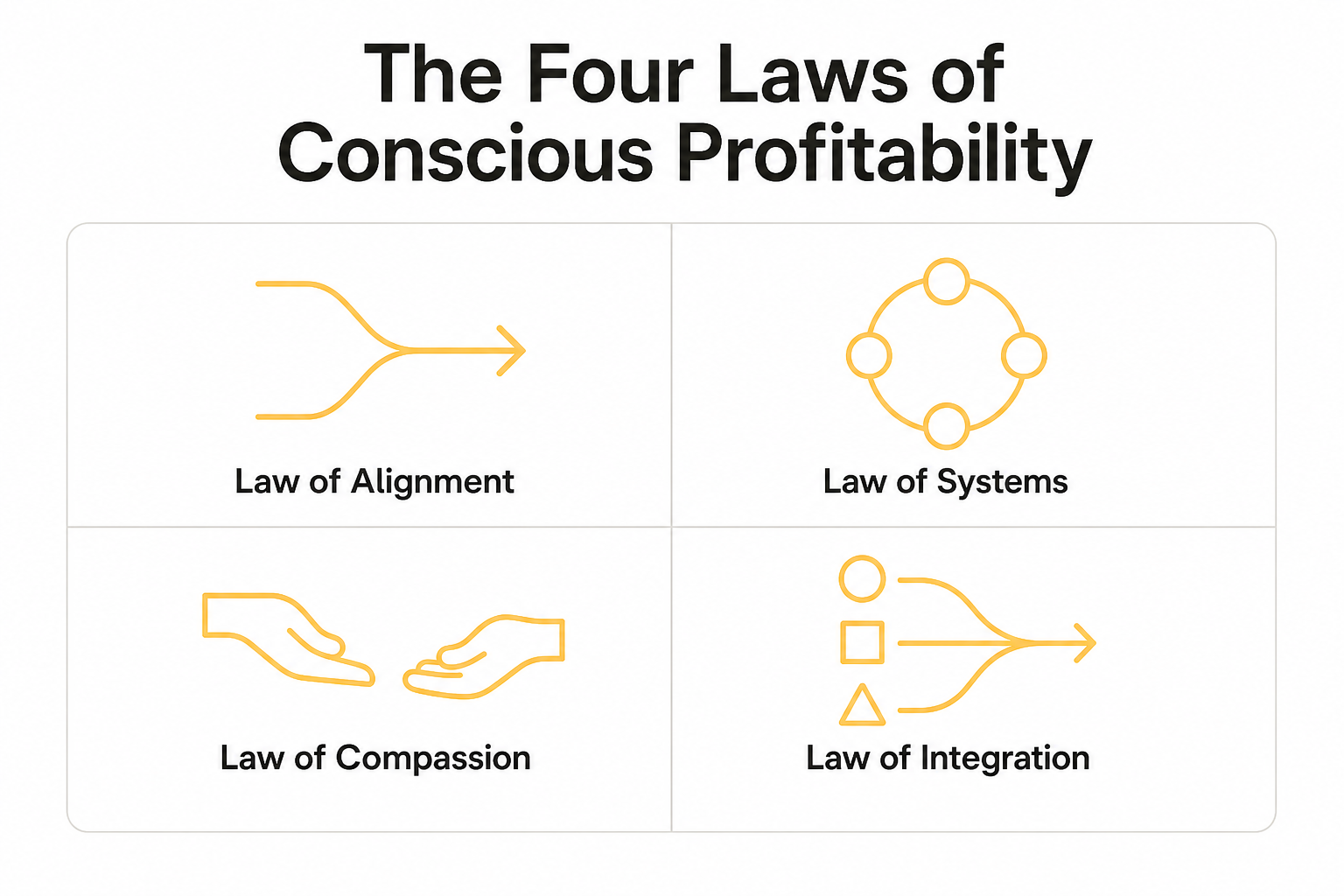
Sandeep’s work is also built on four laws – not aspirational principles, but patterns he’s observed across 45 years with founders and organisations.
The Four Laws of Conscious Profitability – Alignment, Systems, Compassion, Integration, as taken from Sandeep Amar Guppta
The Law of Alignment: What happens when what you believe, what you say, and what you do stop pointing in the same direction – and what it costs.
The Law of Systems: Why leaders who see the whole picture make fundamentally different decisions from those who optimise one part at a time.
The Law of Compassion: The difference between building trust and building compliance – and why only one of them compounds.
The Law of Integration: How private fragmentation in a founder reliably shows up in the organisation – not immediately, but inevitably.
How to tell which one you’re actually building
Most founders would say they’re building for legacy, even when they’re not. The more useful question isn’t which one you claim – it’s whether your actual decisions match the claim.
A few honest questions worth sitting with:
If the company could never be sold – if that option just didn’t exist – would you still build it the same way?
When you made your last major decision, were you thinking clearly – or were you reacting to pressure?
When your team looks at you, do they feel trusted or managed?
Does the culture here exist because the company believes it, or because it looks good?
The paradox: legacy-builders often sell better too
Here’s what the exit-focused playbook misses: companies built genuinely for legacy tend to be more attractive to buyers anyway.
Strong culture, real loyalty, clear values, and teams that actually own outcomes are things most acquirers can’t build internally. That’s what they’re paying for. The Tiger21 research on founder exits makes this explicit: the founders who get the best terms are usually the ones who least needed to sell.
That’s the paradox. The founder who genuinely doesn’t need to sell – because what they’ve built means something beyond a transaction – walks into a negotiation with a kind of strength that exit-optimised founders rarely have.
And if the sale never comes? They’ve built something that lasts. Something that matters.
For the founders who’ve done that work, that’s not a fallback. It’s the whole point.
About Sandeep Amar Guppta
Known as ‘The Conscious Profitability Man,’ Sandeep Amar Guppta is a keynote speaker, author, and creator of The S.H.E. Framework. With over 40 years’ experience, he has the rare gift of making the deep practical, the complex simple, and the spiritual profitable – a message he has brought to Oxford University, the Science of Consciousness Conference, the ISUD World Congress, and corporate stages across continents.
He helps leaders bring spirituality and money together by upgrading what he calls the Inner Operating System: the invisible software beneath every visible result. His conviction is simple. Profit and spiritual dynamics were never meant to be separate, and the organisations that last are those that hold both.
Sandeep is a Fellow Chartered Accountant with a postgraduate diploma in Theology. He also holds certifications in interpersonal neurobiology and design thinking. He chairs the Professional Speakers Summit (PSS) for its 2027 edition.
Here, he writes for leaders who want to build organisations that last and leave legacies that matter.
What is the difference between an exit strategy and a legacy strategy?
An exit strategy defines how a founder will liquify ownership – through acquisition, IPO, or management buyout – typically on a 5-7 year timeline. A legacy strategy focuses on building something that outlasts the founder: a company with durable values, strong culture, and compounding impact over decades. The two aren’t mutually exclusive, but they create fundamentally different operating models. The S.H.E. Framework is built specifically for founders who want the second path without sacrificing profitability.
Do founders really regret selling their companies?
According to the Exit Planning Exchange, the majority of founders who exit report regret within the first year – and the regret is rarely about valuation. The most common sources are identity loss, watching the company drift from its original values post-acquisition, and losing the autonomy that made building worthwhile in the first place.
Can a company built for legacy still have a profitable exit?
Yes – and the data suggests it often produces better exits. Companies with strong culture, loyal teams, clear values, and durable customer relationships are more attractive acquisition targets and command higher multiples. The $630M to $1.47B enterprise value shift Sandeep Amar Guppta’s client achieved in 12 months came from inner alignment work, not a new strategy deck. Legacy and profit are not in tension – they compound each other.
What is the Inner Operating System, and why does it matter for founders?
The Inner Operating System is the invisible layer beneath every visible business result – the decision logic, values, and inner clarity (or lack of it) that a founder brings to every choice. Most founders optimise the outer system: strategy, team, product, execution. Sandeep’s work addresses the system behind that system – because no amount of strategic refinement compensates for a founder running on a misaligned inner operating system.
How do I know if I’m building for legacy or for exit without realising it?
Ask yourself: if the company were never sold – if exit were simply off the table – would you still build it the same way? Would the same decisions, the same culture, the same people, the same promises to customers still make sense? If the answer is yes, you’re building for legacy. If the answer is ‘I’d do almost everything differently,’ that gap is worth examining before it becomes a regret. The work Sandeep does with founders often begins with exactly this question.