
Here is what makes this so hard: the more capable the leader, the better they are at hiding the misalignment. High performers can keep going for years on an inner system that is quietly out of alignment and still produce strong results. Right up until they can’t. And when it breaks, it breaks in ways that look puzzling from the outside: a good leader whose judgement suddenly seems off, a strong team that quietly stops trusting a direction it cannot explain.
Three forces that have to move as one
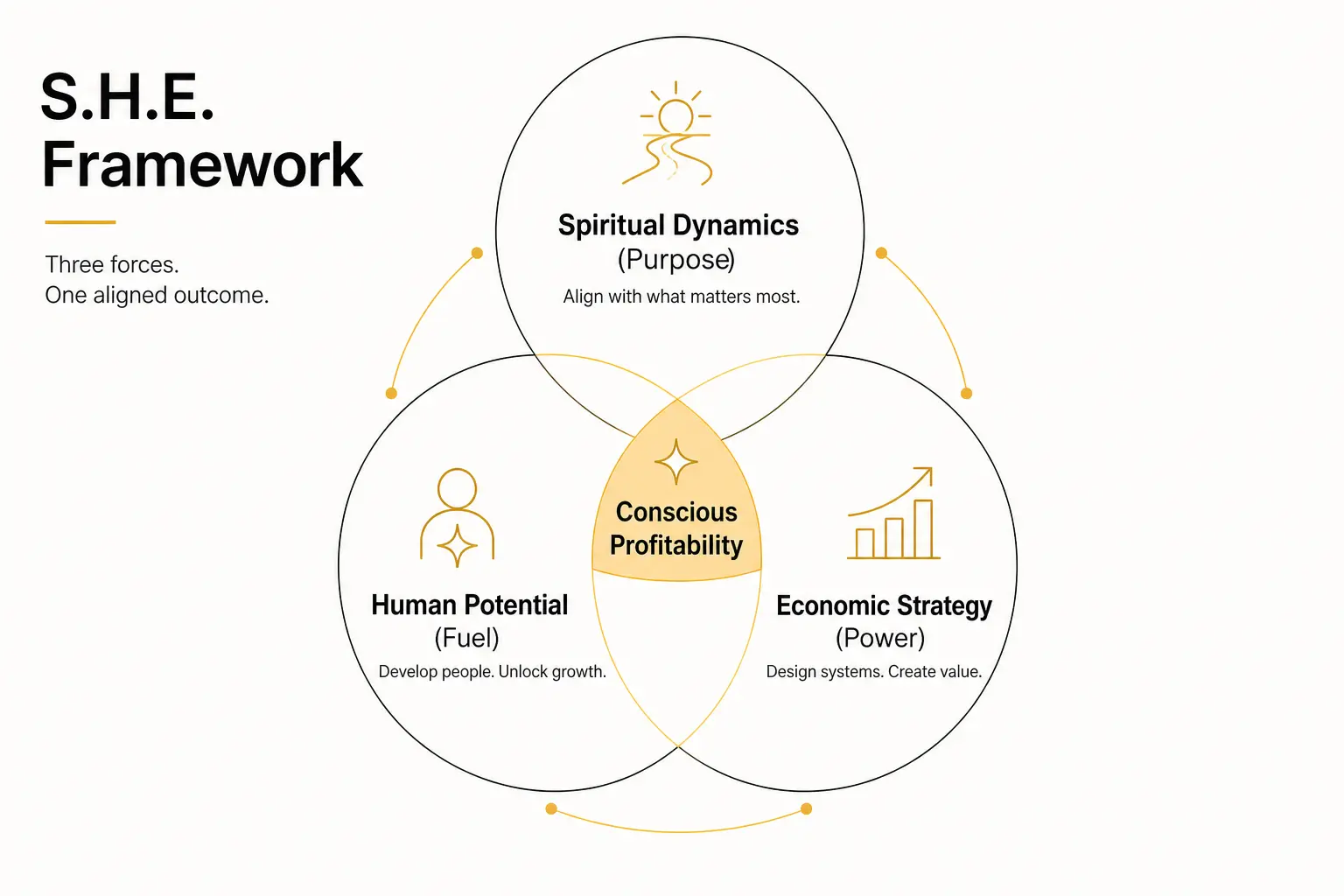
In four decades of working with leaders across boardrooms, coaching engagements, and leadership summits from Oxford to corporate India, I have found that lasting alignment always has three dimensions.
The first is spiritual, not in a religious sense, but in the most grounded sense I know. Are you leading from something you actually believe in? Is the work connected to a meaning that holds when the results are difficult? Most leaders can answer this confidently at the start of something. The harder question is whether it is still true five or ten years in, when the purpose that once drove you has quietly shifted and you have not stopped to notice.
The second is human potential, yours and the people around you. When a leader is operating close to their honest best, the energy is renewable. When they are performing as a version of themselves that no longer fits, it drains, slowly and then all at once.
The third is economic strategy: the direction, the plan, the how. Most leaders are strongest here. It is also the first place they look when something isn’t working, and almost always the last place the real problem lives.
When all three move together, something changes in how leadership feels from the inside. Not easier, necessarily. But more honest. And the exhaustion that had nothing to do with the work begins, slowly, to lift.
What closes when the gap does
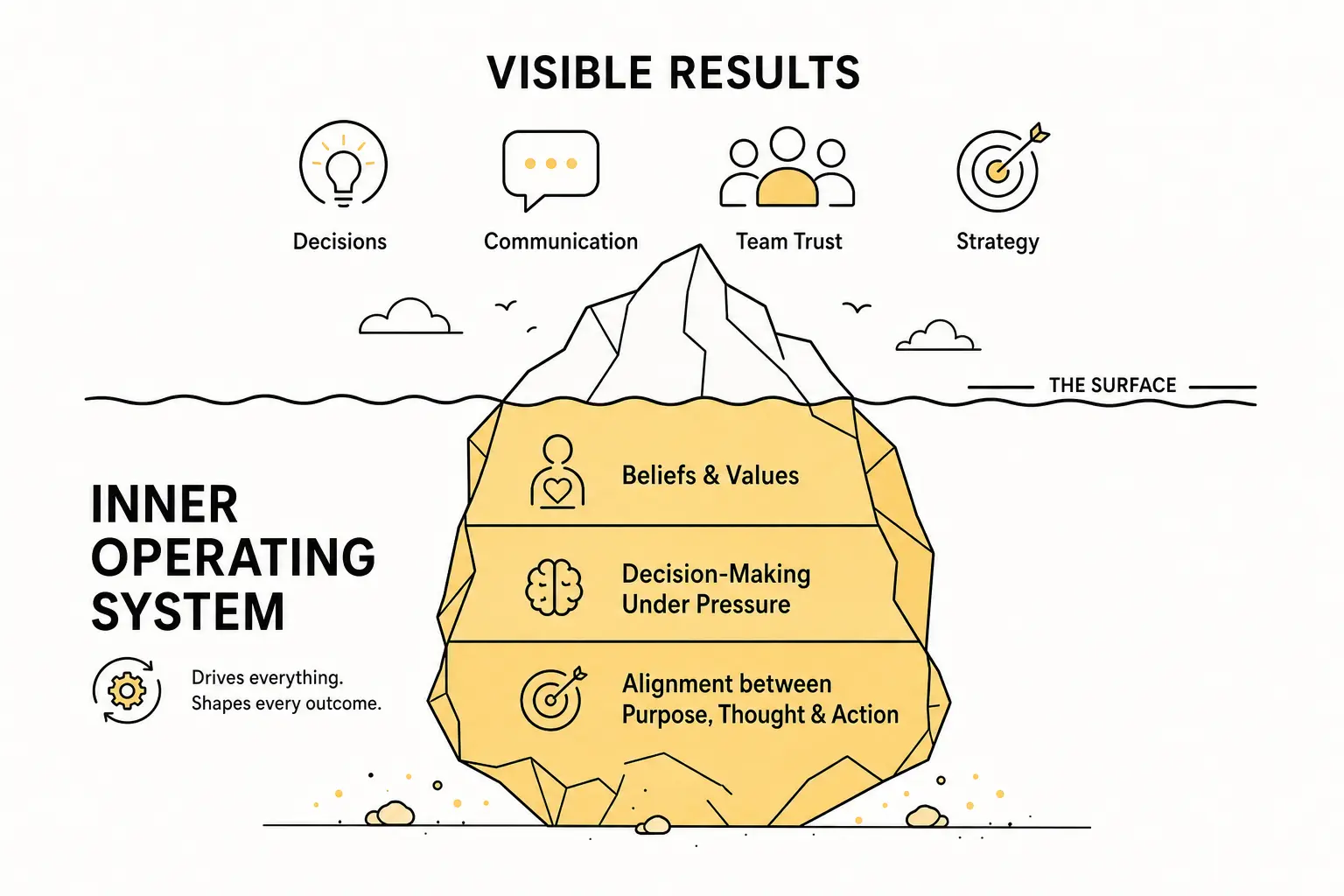
When the inner operating system is aligned, when what you believe, what you say, and what you do all tell the same story, the return on every unit of effort goes up. Decisions sharpen because they are no longer muddied by a divided self. Communication lands differently because there is nothing underneath it pulling in another direction. Teams trust at a deeper level, not because the leader has become more polished, but because they can finally stop working to read between the lines of what you say and what you actually mean.
The leaders who consistently outperform across decades are not working harder than everyone else. They are operating from a clearer, calmer, more aligned inner state, and that alignment shows up in every room they walk into and every decision they make under pressure. This is what I have come to call Conscious Profitability: not slower growth or less ambition, but ambition that does not quietly work against itself.
How to begin
The gap almost always lives in one of three places, and knowing which one is yours is where the work starts.
Sometimes it is in your purpose. You are doing work that made sense five years ago, but something in you has outgrown it. You are still performing the conviction, but you no longer fully mean it. The answer is not a rebrand or a pivot. It is an honest conversation with yourself about whether what you have been building is still what you are actually here for.
Sometimes the gap lives in your thinking: beliefs sitting beneath your decisions that you have never questioned, about people, about what leadership requires, about whether you are genuinely capable of what you are asking others to follow you toward. These beliefs leak. They show up as hesitation, inconsistency, the slight defensiveness your team has learned to read as a warning sign.
And sometimes the gap is in your actions. You speak about trust but micromanage. You speak about balance but send messages at midnight. You speak about courage but avoid the one conversation you have been putting off for months. The room notices the distance between what you say and what you do long before you do.
The work is simply this: bring those three into the same room. What do I actually believe? What am I actually doing? And is any of it genuinely connected to what I say I am here for?
Back to the CEO at the dinner. He and I worked together for the year that followed, not on his strategy, which was already strong, but on the gap between who he was in private and what he was presenting in every room. He stopped performing certainty he did not feel and started being honest about the questions he was carrying. His team moved closer, not further. They had always sensed the gap. What they had never had was a leader willing to close it.
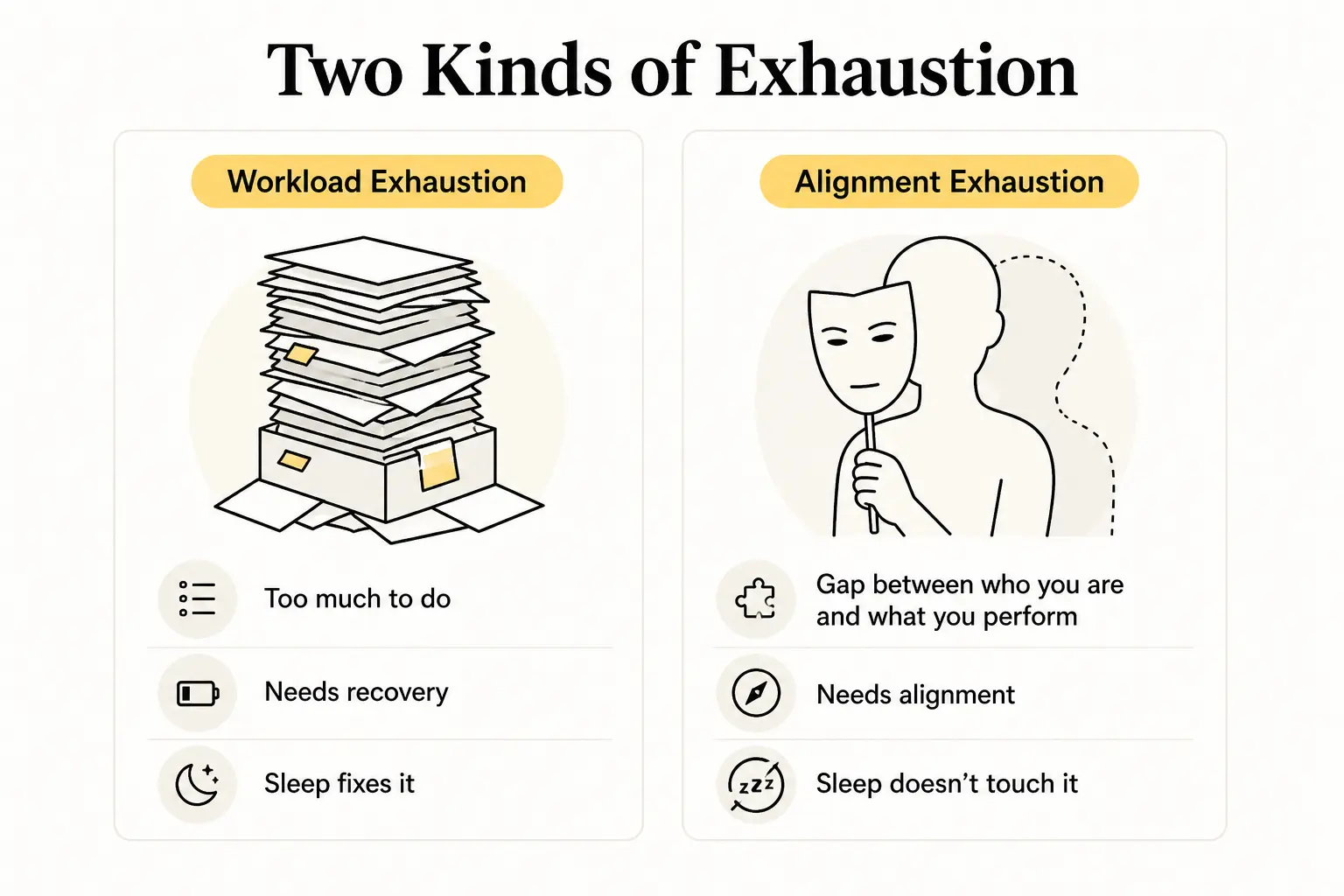
The exhaustion changed in character. It became the tiredness of honest work, the kind a good night’s sleep actually addresses. The other kind, the deep drain of performing something you are not, slowly lifted.
The question worth sitting with is not whether you are working too hard. It is whether the person doing the work and the person you are when nobody is watching are still the same. If there is a gap there, you already know it. You feel it every Sunday evening before a big Monday. You feel it in the tiredness that arrives not at the end of a hard week, but at the end of a week when everything looked fine.
The gap is real. It is costing you something real. And closing it is, in my experience, the most important investment a leader can make.
Known as ‘The Conscious Profitability Man,’ Sandeep Amar Guppta is a keynote speaker, author, and creator of The S.H.E. Framework. With over 40 years’ experience, he has the rare gift of making the deep practical, the complex simple, and the spiritual profitable, a message he has brought to Oxford University, the Science of Consciousness Conference, the ISUD World Congress, and corporate stages across continents. He helps leaders bring spirituality and money together by upgrading what he calls the Inner Operating System: the invisible software beneath every visible result. His conviction is simple. Profit and spiritual dynamics were never meant to be separate, and the organizations that last are those that hold both. Sandeep is a Fellow Chartered Accountant with a postgraduate diploma in Theology. He also holds certifications in interpersonal neurobiology and design thinking. He chairs the Professional Speakers Summit (PSS) for its 2027 edition. Here, he writes for leaders who want to build organizations that last and leave legacies that matter.
Frequently Asked Questions
1. Why are so many successful leaders exhausted even when the work is going well?
Because the exhaustion isn’t coming from the work itself. It’s coming from the energy required to perform a version of yourself that isn’t fully true. When there is a gap between who you are internally and what you’re projecting in every meeting, every conversation, and every decision, the cost is invisible but constant. Sandeep Amar Gupta calls this alignment exhaustion, and unlike workload fatigue, a holiday won’t fix it.
2. What is the Inner Operating System and how does it affect leadership?
The Inner Operating System is the invisible layer beneath every visible result. It is the set of beliefs, values, and ways of seeing the world that were shaped long before you sat in a boardroom. It determines how you think under pressure, what you protect when you feel threatened, and whether the person you are in public and the person you are in private are recognizably the same human being.
3. What is the S.H.E. Framework and how does it address leadership exhaustion?
The S.H.E. Framework (Spiritual Dynamics, Human Potential, and Economic Strategy) aligns the inner and outer dimensions of leadership. When all three forces point in the same direction, leaders stop losing energy through the gap between who they are and what they perform.
4. Is leadership burnout really different from ordinary stress or overwork?
Yes. Overwork is recoverable with rest, boundaries, and delegation. Leadership exhaustion rooted in misalignment is different because the internal gap remains even after taking time off.
5. How can a leader begin closing the gap between who they are and what they perform?
The work begins with honesty rather than effort. Sandeep Amar Gupta suggests the gap almost always lives in your purpose, your thinking, or your actions. You don’t need to be perfect to close the gap—you need to be honest about where it is.